Logos aren’t made the way they used to be.
A founder with zero design background can now type a prompt into a tool and walk away with a polished mark in under a minute. No sketching. No revisions. No designer required.
Convenient? Absolutely. But there’s a catch.
Telling the difference between a thoughtfully crafted brand asset and an AI generated logo is getting harder. And if you’re building a brand, buying one, or trying to protect one, that difference matters.
So here’s how to spot machine-made designs, why they’re shaking up branding standards, and what to do about it.
Key Takeaways
- AI generated logos often show telltale signs. Over symmetry, generic motifs, and typography glitches.
- The best AI logo generator tools raise the floor of design quality, but not the ceiling.
- Verification tools like an AI image detector help you catch what your eye might miss.
- Strategy, not speed, is still what makes a logo work long-term.
What Is an AI Generated Logo, Anyway?
An AI generated logo is exactly what it sounds like. A logo created by a generative model instead of a human designer.
You feed the tool a prompt (“minimalist logo for a coffee brand, warm colors, circular”), and it produces a mark in seconds. Some tools offer light editing. Most don’t.
The category has exploded. Small businesses use them for speed. Freelancers use them for early exploration. Even agencies use them for quick concepting. But regardless of the tool, the fundamentals of great design like minimalism and restraint are still what separates a memorable logo from a forgettable one.
The problem isn’t the tool. It’s what gets skipped.
Traditional identity work involves research. Audience, competitors, cultural cues, how the mark scales. Generative models don’t do any of that. They average patterns from training data and hand you what statistically looks like a logo.
Sometimes that’s enough. Often it’s not.
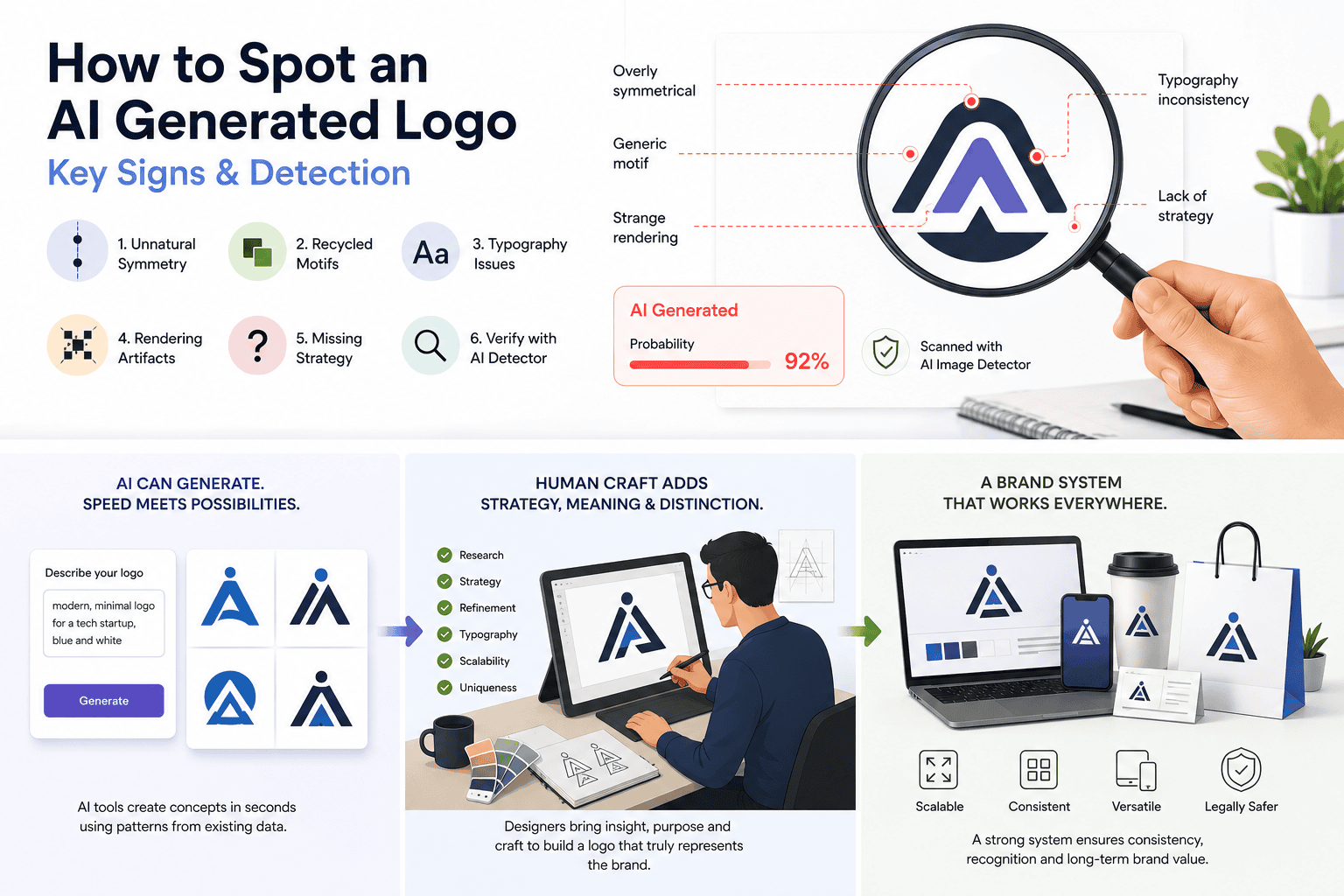
6 Telltale Signs of an AI Generated Logo
Trained designers can usually clock machine-made work in seconds. Here’s what they’re looking at, so you can look too.
1. Unnatural Symmetry
AI models over-optimize for balance.
A skilled designer breaks symmetry on purpose. They shift weight, tilt an angle, or nudge a curve to create tension and personality. AI does the opposite. Every element sits exactly where a formula would put it.
The result? A logo that feels sterile instead of distinctive.
2. Recycled Visual Motifs
Generative tools pull from massive datasets, so they gravitate toward whatever shows up most often in a category.
Fitness brands get flames or dumbbells. Tech companies get abstract hexagons. Coffee shops get bean silhouettes. Yoga studios get lotus flowers.
If a logo feels like a mashup of five other logos in the same industry, that’s a giveaway.
3. Typography That’s Almost Right
Type is where AI still struggles the most.
Watch for slightly off letter spacing, mismatched stroke weights, or characters that look like they wandered in from a different font family. An “R” whose leg doesn’t quite match the rest. An “a” that feels a size too small.
Real designers don’t leave these mistakes. AI does, constantly.
4. Rendering Artifacts
Even the best AI logo generator tools leave traces.
Look closely at negative space, corner joins, and where curves meet straight lines. You might spot stray anchor points, faint blurs, or gradient banding that a designer would never let through.
On raster exports, look at the edges. Hallucinated pixels, faint shadows, subtle warping. All giveaways.
5. Missing Strategic Logic
This one takes more experience to see, but it’s the biggest tell.
Ask yourself. Does this logo mean something? Does it connect to what the brand actually does? Or does it just look like a logo?
AI generated logos tend to look good and mean nothing.
6. When Your Eye Isn’t Enough
Eyeballing gets you far. But it doesn’t scale.
If you’re vetting a batch of submissions, running a competitive audit, or checking a mark before a trademark filing, you need a second opinion that isn’t your own tired eyes at 11 p.m. That’s where an AI image detector earns its keep. Upload the file, get a probability score, and pair it with your judgment.
Agencies use these tools to screen client-supplied assets before a rebrand kicks off. Design directors use them to vet portfolio submissions. Journalists use them to check whether logos floating around on social media are real brand assets or fabrications.
Are detectors perfect? No. False positives happen. But combining automated analysis with a trained eye is far more reliable than either one alone.
What the AI Logo Boom Means for Branding Standards
The best AI logo generator platforms are producing marks in minutes that used to take hours.
That’s genuinely exciting. It’s also reshaping what “good” means in branding, and not always for the better.
Here’s what’s shifting.
The Baseline Just Moved
Clients who used to accept rough mockups now expect polished output at every stage. Designers are being asked to move faster without compromising strategy.
The floor is higher. The ceiling hasn’t budged.
Differentiation Is Getting Harder
When thousands of businesses use the same generator, category-wide sameness starts to eat away at brand distinctiveness. Which, if you think about it, is the whole point of a logo.
Add motion to the mix, and it gets more complicated. Modern brands need marks that flex across formats, which is why designing logos for motion, not just static screens, is quickly becoming a baseline expectation, not a bonus.
Legal Risks Are Climbing
AI models can quietly produce marks that resemble existing protected designs. That’s how brands end up in trademark disputes they never saw coming.
One thing worth knowing. AI produced work may not qualify for full copyright protection in some jurisdictions. So even if the logo is technically “yours,” you may not be able to fully enforce ownership of it.
How Designers and Brands Can Adapt
For Designers, Integrate Rather Than Resist
Trying to fight AI in your workflow is a losing game. Use it for what it’s good at. Ideation, mood exploration, quick iteration.
Then apply the craft. Refine the mark. Build a strong logo system around it, with clear variants, spacing rules, and usage guidelines. That’s what turns a generated concept into an asset that scales without breaking.
Document your process. Show clients where human decisions shaped the outcome. That transparency is fast becoming a real competitive advantage.
For Brand Owners, Do the Due Diligence
Before you adopt any AI generated logo as your permanent identity, do three things.
- Run it through a detector.
- Order a proper trademark search.
- Stress test the mark across sizes, backgrounds, and media.
A logo has to work everywhere from web to product packaging. Ask yourself whether it actually tells your brand’s story or just happens to look good in a template mockup.
A logo that can’t answer strategic questions won’t survive the next stage of growth. Doesn’t matter how it was made.
Conclusion
An AI generated logo isn’t automatically a bad logo. A human-made mark isn’t automatically a great one, either.
What matters is whether the final asset actually serves the brand. Clearly, distinctively, and over time.
Learn to read the signals. Use verification tools when the stakes are high. And keep brand consistency across every website and touchpoint, because a logo that shifts context to context isn’t really a logo. It’s a suggestion.
The designers and brands who win the next chapter will be the ones who treat AI as a collaborator, not a shortcut.
One final tip. Don’t skip the strategy step just because the visual came together fast. A five-minute logo can still take five weeks of thinking to be worth using.
FAQs
1. How can you tell if a logo was made by AI?
Look for over-symmetrical geometry, generic industry motifs, typography inconsistencies like mismatched letter weights, and small artifacts around curves or corners. When in doubt, run it through an AI detection tool for a second opinion.
2. Is it legal to use an AI generated logo for a business?
In most regions, yes. But there are caveats. AI produced work may not qualify for full copyright protection in some jurisdictions, and generated marks can accidentally resemble existing trademarks. A proper trademark search before adoption is a must.
3. What is the best AI logo generator to use right now?
It depends on what you need. Some tools focus on speed and simplicity for small businesses. Others give designers more control over vectors and typography. Whichever one you pick, treat the output as a starting point, not a final identity.