
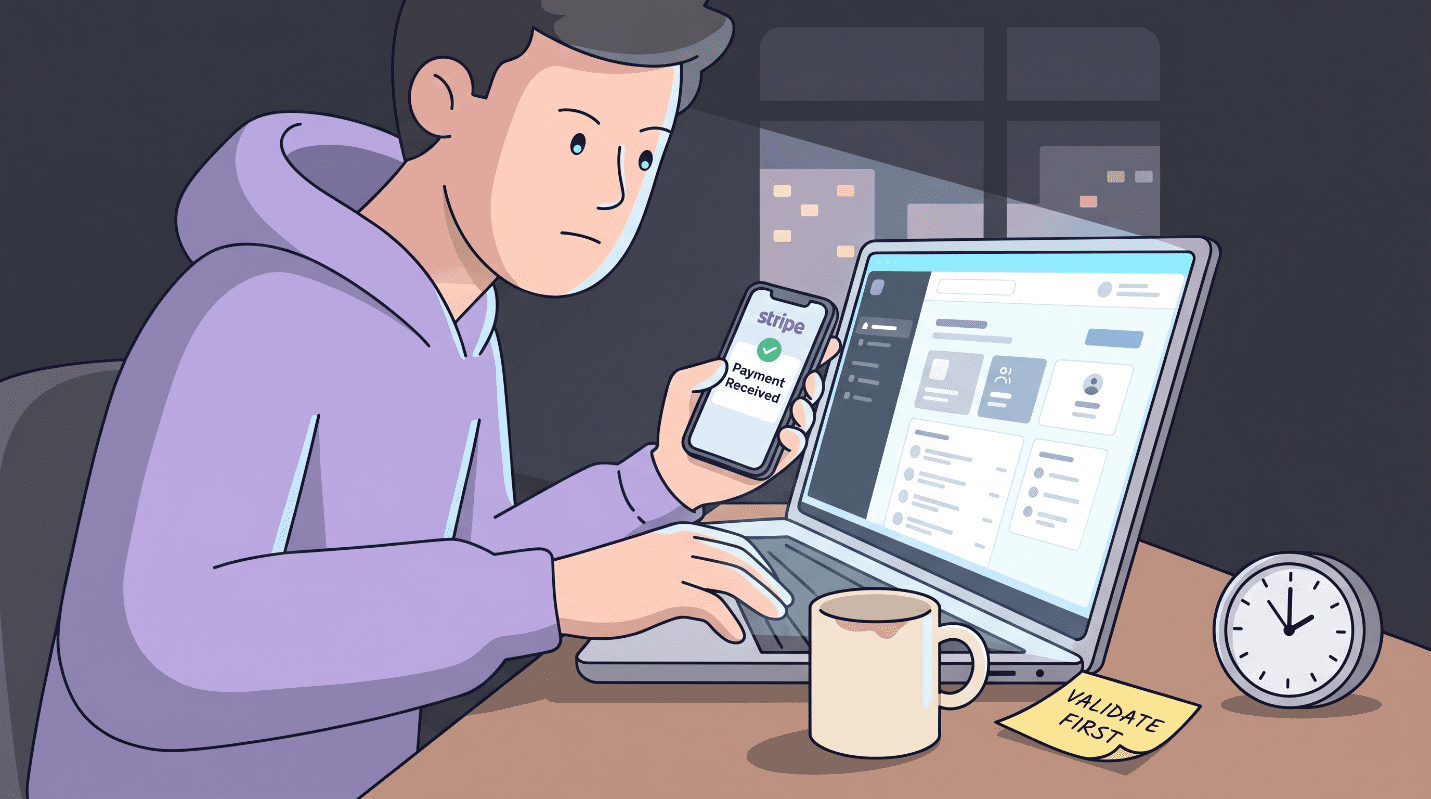
(Most People Spend 6 Months Getting Ready to Build. You Don’t Have To.)
If you’re sitting on an idea right now, waiting until the timing is right or the budget is there this is the article that changes how you think about that.
Nobody Pays for an Idea. They Pay for a Product.
Here’s the uncomfortable truth that most startup content refuses to say plainly: until someone hands you money, you don’t have a business. You have a hypothesis.
Founders spend months perfecting pitch decks, writing business plans, mapping out feature roadmaps all before a single real user has seen the product. And somewhere in month four, after burning through savings and goodwill, they discover the market doesn’t actually want what they built.
The answer to this problem isn’t more planning. It’s faster proof.
The 6-Month Trap and How You Fall Into It
Ask any non-technical founder how long it took to get their first MVP live. The honest answers cluster around the same painful range: four months, six months, eight months. And that’s if they shipped at all.
The timeline isn’t their fault. It’s the system.
Here’s what the traditional path actually looks like:
| Week 1–2 | Searching for a developer, explaining your idea from scratch |
| Week 3–4 | Back-and-forth on scope, wireframes, and discovery sessions |
| Week 5–8 | Development begins —> you see nothing |
| Week 9–12 | A demo appears, revisions start, scope creep sets in |
| Week 13–16 | QA, deployment, DNS issues, staging environments |
| Week 17 | You launch. The market has moved. Your assumptions were 6 months old. |
By the time you reach your first potential paying user, you’ve spent tens of thousands of dollars and enormous mental energy on something that still might not work.
Is this the issue right ? There is a better sequence. And it starts with reversing the order of operations.
Validate First. Build Second. That’s It.
The founders who find their first paying user fastest share one habit: they show something real before they feel ready.
Not a pitch deck. Not a Figma mockup. Not a ‘coming soon’ page. A working product something a person can click through, experience, and decide to pay for.
The gap between ‘I have an idea’ and ‘I have a working product someone can try’ used to take months. That gap is now measured in hours.
Imagine.bo is built specifically for this moment. Describe your idea in plain English who it’s for, what it does, what the core rules are and the platform generates a complete, full-stack application. Real database. Real backend logic. Real authentication. Real frontend. Not a template you tweak. Software that actually works.
| Your 24-hour window opens the moment you stop planning and start generating. |
What ‘Vibe Coding’ Actually Means at This Level
There’s a version of vibe coding that means drag-and-drop landing pages with a contact form. That’s not this.
When Imagine.bo builds your app, it architects the full stack automatically:
- Database schema 🡪 tables, relationships, and data models built for your specific use case
- Backend logic 🡪 API endpoints, workflow triggers, business rules
- Authentication 🡪 secure login, signup, session management, and role-based access control out of the box
- Responsive frontend 🡪 a UI that works on desktop and mobile from day one
- Production deployment 🡪 Vercel for the frontend, Railway for the backend, with SSL and autoscaling included
This is what a two-person engineering team would spend their first month building before writing a single line of product-specific code. You get all of it in minutes. And you iterate not by reopening a code editor, but by continuing the conversation:
- “Add a pricing page with three tiers.”
- “Only logged-in users should be able to submit a form.”
- “Send a confirmation email when someone signs up.”
The AI updates the underlying code in real time. You stay in the builder role, not the debugger role.
The 24-Hour Path: What It Actually Looks Like
Hour 1 🡪 Write the prompt. Spend the first hour getting clear on three things: who the user is, what problem they have, and what the one core action of your product is. The more specific your prompt, the more accurate your build.
A strong prompt: https://docs.imagine.bo/prompting
A weak prompt: “Build something like FreshBooks.”
Hour 2–3 🡪 Generate and review. Submit your prompt and let the AI build. Review the generated blueprint check that core screens exist, roles are correct, and the main workflow makes sense. Use follow-up prompts to fix anything missing. This is not a restart. It’s a conversation.
Hour 4–6 🡪 Refine and brand. Use the drag-and-drop editor to apply your visual identity. Replace placeholder copy with real content. Add your pricing. Preview the mobile experience.
Hour 7 🡪 Deploy. One click. Your app is live on real infrastructure. You have a URL you can share.
Hours 8–24 🡪 Get it in front of people. Post in the communities where your target user spends time. DM the people most likely to benefit. Offer early access. Talk to everyone who signs up. One of them will pay you if the product solves a real problem.
What Happens When You Hit the Hard Part
At some point in your first 24 hours or your first week you’ll need something more specific than the AI can generate cleanly. A Stripe integration with your local payment processor. A custom data export format. A third-party API with unusual authentication.
This is the moment that ends most vibe code journeys. But it doesn’t have to.
Imagine.bo has a feature built directly into the dashboard called “Hire a Human.” Click it, describe the specific task, and a verified engineer picks it up writes the custom module, pushes it to your project, and hands it back. No onboarding. No context-switching. No watching your momentum die while you search for a freelancer.
| The AI built 80%. The human closes the 20%. Your product ships. |
The First Paying User Is a Mindset Shift, Not a Milestone
Most founders treat the first paying user as a finish line. It’s actually a starting gun.
Getting someone to pay you even one person, even a small amount changes everything about how you build next. You have real feedback from a real decision. You know the problem was real enough for someone to spend money on. You know what they actually used versus what you assumed they’d use.
The founders who find this user in 24 hours aren’t luckier or more talented. They’re faster to the proof. They don’t wait until the product feels ready. They put something real in front of people and let the market tell them what to do next.
No team required. No code required. Just a clear idea, a specific prompt, and the willingness to launch before you’re comfortable.
Plans That Match Where You Are Right Now
Pricing are very nominal starting from “free”, where you can login start building , the base comes under $5/month.
Unused credits roll over on paid plans. Top-ups are available mid-month without changing your plan. Every tier ships with SSL, authentication, and role-based access control included.
You’re One Prompt Away From a Product Someone Can Pay For
The idea is already there. The market isn’t waiting for you to feel ready. Your first paying user isn’t going to find you. You have to put something in front of them first.
The question isn’t whether you can build it. It’s whether you’ll start today or in six months.
Start for free at Imagine.bo no credit card, no team, no code required.
Describe it. Build it. Get paid for it.