
Shopping feeds have quietly become the front line of brand visibility for online retailers. Before a shopper ever reaches a product page, they scan a grid of thumbnails on Google Shopping, swipe through a Meta catalog, or pause on a TikTok Shop card. Each of those surfaces is governed by a different image policy, a different aspect ratio, and a different algorithmic sense of what looks trustworthy enough to surface. The brand mark, the color palette, and the way a product is photographed now carry more commercial weight in that grid than they ever did on a brand homepage.
This article looks at what actually performs in shopping feeds across Google, Meta, and TikTok Shop. It covers platform-specific image rules, the right way to handle logos and overlays, how color and contrast influence both algorithms and shoppers, and where studio photography stops outperforming lifestyle imagery. The aim is a practical visual playbook for designers and brand owners who want their products to win the scroll.
The Shopping Feed Is Where SEO and Visual Identity Collide
Product feeds sit at a strange intersection of disciplines. On one side, they are structured data systems shaped by titles, product attributes, categories, availability, pricing, landing pages, and other signals that behave a lot like classic ecommerce SEO. On the other, the thumbnail is often the first — and sometimes only — thing a shopper notices before deciding whether a product deserves a click.
That is why feed performance cannot be treated as a purely technical task or a purely creative one. A perfectly optimized product title will struggle if the image looks unclear, inconsistent, or untrustworthy in the grid. A beautiful product photo can also underperform if the feed is missing key attributes, uses weak category mapping, or sends shoppers to a page that does not match the promise of the visual.
For ecommerce brands that want to connect product visibility with stronger organic growth, working with a ROI-driven SEO partner like SeoProfy can help align product pages, category structure, search intent, and visual assets into one measurable performance system.
Why Is This Critical?
The challenge is that every shopping surface evaluates visuals differently. Google Merchant Center places heavy emphasis on clear, compliant product images: no promotional overlays, no watermarks, no added logos, and enough resolution for the product to be displayed cleanly.
Meta catalogs give brands more creative flexibility, but product images still need to survive cropping, placement changes, and variant-level consistency across Facebook and Instagram. TikTok Shop adds another layer: listing images must follow strict marketplace rules, while videos and supporting creative often perform best when they feel native to the platform.
None of these issues can be solved through metadata alone. Feed images now have to do several jobs at once: satisfy platform requirements, represent the brand accurately, make the product easy to understand at thumbnail size, and create enough visual distinction to earn attention in a crowded grid. That makes the brand layer — logo treatment, color discipline, photography style, background choice, and image consistency — inseparable from feed performance.
Platform-by-Platform Image Standards
Each major shopping surface enforces its own rules, and a single master asset rarely satisfies all three. Below is a working summary of the requirements designers run into most often. Specifications change periodically, so the official merchant documentation should always be the final reference before any campaign launches.
Google Shopping (Merchant Center)
Google’s Merchant Center remains the most prescriptive of the three. Non-apparel products require a minimum of 100×100 pixels, while apparel items need at least 250×250 pixels; recommended dimensions sit at 800×800 or larger for both. The product must fill roughly 75 to 90 percent of the frame, and the background of the main image must be plain white, gray, or transparent. Lifestyle and contextual shots are now permitted in additional image fields, which gives brands a second visual lane to work with.
The rules around overlays are strict. Google rejects promotional text, watermarks, sale stickers, and graphical badges that were not part of the product itself. Brand logos are tolerated only when they appear naturally on the product or packaging, never when they sit on top of the image as a sticker.
Meta Catalog (Facebook and Instagram Shopping)
Meta is more permissive than Google on creative latitude but stricter on aspect ratio consistency. Square 1:1 images at 1024×1024 or larger render best across both Facebook and Instagram surfaces, and the catalog system will crop non-square uploads in unpredictable ways. Promotional overlays are technically allowed in catalog images but get penalized when those items move into ad placements through Advantage+ Shopping campaigns, which is where most catalog traffic ultimately ends up.
TikTok Shop
TikTok Shop runs on a younger, video-native logic. Static product images still matter for the product card, but the recommendation engine favors creative that feels closer to user-generated content than to studio retail photography. Minimum image sizes start around 600×600 pixels, and the platform rejects watermarks, contact information, and competitor logos. Variant consistency is enforced more aggressively here than on either Google or Meta.
Quick Reference: Image Requirements Across Major Shopping Feeds
| Platform | Min. Resolution | Preferred Ratio | Background | Overlays |
| Google Shopping (non-apparel) | 100×100 | 1:1, 800×800 recommended | White, gray, transparent | Not permitted |
| Google Shopping (apparel) | 250×250 | 1:1, 800×800 recommended | White, gray, transparent | Not permitted |
| Meta Catalog | 500×500 | 1:1, 1024×1024 recommended | Flexible | Allowed; penalized in ads |
| TikTok Shop | 600×600 | 1:1 | Clean, neutral preferred | Not permitted |
Logos in Shopping Feeds: Where Brand Meets Policy
The logo is one of the most policy-sensitive elements in any shopping feed. Designers come from a world where the brand mark belongs on every surface; merchants soon discover that platforms treat that instinct as a violation. Understanding what is allowed, where, and in what form is the single biggest brand-safety question in feed design.
The general principle across Google, Meta, and TikTok is that the brand mark may appear when it is physically part of the product (printed on a shoebox, embossed on a wallet, sewn onto a label) and must be removed when it is placed on top of the image as a graphic overlay. The rule sounds simple, but breaks down quickly when packaging itself is the product, when bundled items contain multiple logos in frame, or when retailers resell branded merchandise and need to comply with both platform policy and trademark agreements.
A useful working checklist for logo handling in feed images:
- Keep the brand mark only where it appears physically on the product or its packaging
- Strip out reseller stickers, sale badges, and as-seen-on graphics before export
- For bundles, lead with the hero item and let supporting product logos appear at natural scale
- For unbranded white-label goods, do not invent a logo lockup just for the thumbnail; the algorithm reads inconsistency between the feed and the landing page
- Maintain a separate library of feed-safe images, kept distinct from the lifestyle and marketing libraries, so the wrong asset cannot enter the catalog by accident.
For brand teams that want to align their feed visuals with broader identity work, the principles overlap with the wider case for visual branding for a successful eCommerce store, where the logo system, packaging, and digital storefront all need to operate as one coherent surface rather than three disconnected ones.
Color and Contrast: The Two Variables Shoppers Actually See
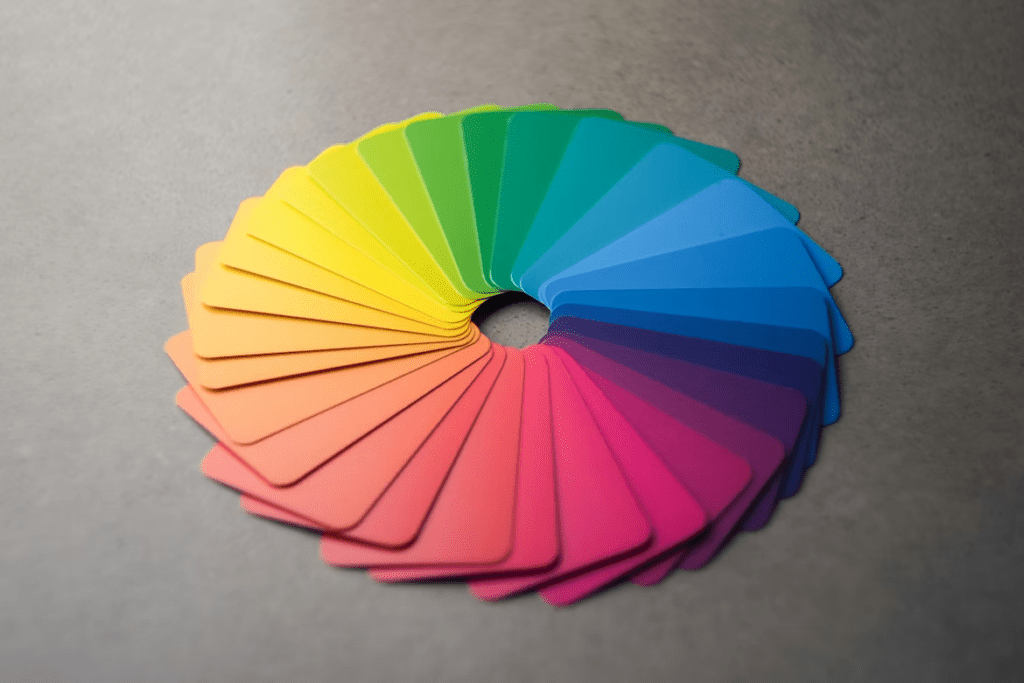
In a feed grid, color does more visible work than typography, photography style, or even price. A product card occupies a tiny share of the screen, often viewed for less than a second, and the eye is drawn to whatever contrasts most sharply against the surrounding cards.
Two pressures act on color decisions in feeds:
- Differentiation pressure: A thumbnail that blends into the dominant palette of competing listings will lose impressions. White-on-white backgrounds especially struggle when the platform shows a full grid of similar products from multiple sellers.
- Accuracy pressure: Shoppers return products that arrive looking different from the thumbnail. Oversaturated or color-shifted images may win the click but raise return rates, which platforms increasingly weigh in their long-term ranking signals.
The practical compromise is to keep the product itself colorimetrically accurate while controlling the surrounding environment (shadow, surface, prop palette) to lift the product visually. A muted background almost always does more for a saturated product than another saturated tone competing with it.
Color Behavior in Shopping Grids
| Product Type | Background That Tends to Work | Background That Tends to Fail |
| Bright primary colors | Neutral mid-gray, off-white, soft taupe | Pure white; matching primary tones |
| Muted earth tones | Clean white, pale stone | Other earth tones (loss of separation) |
| Black or dark monochrome | Light gray with subtle shadow | Pure white; dark backgrounds |
| Glossy or reflective products | Diffused light gray | Pure white; dark surfaces (reflection artifacts) |
| Multicolor apparel | Plain neutral around #F5F5F5 | Patterned or textured surfaces |
Studio Versus Lifestyle: Choosing the Right Lane for Each Image Slot
Most platforms now allow at least one lifestyle or contextual image alongside the studio hero. Used well, this slot lifts engagement; used carelessly, it confuses both the algorithm and the buyer.
When Studio Photography Wins
The main feed image, the thumbnail that appears in the grid, should almost always be a clean studio shot. Studio images make scale unambiguous, surface details clearly, and pass image quality checks more reliably than lifestyle alternatives. They are also easier to keep consistent across variants and SKUs, which directly affects how the platform groups a brand’s catalog.
When Lifestyle Photography Wins
Secondary images, the ones that appear when a shopper expands a listing, are where lifestyle work earns its budget. Lifestyle helps in three specific situations: when scale is hard to communicate (small accessories, large furniture), when use case is non-obvious (specialty kitchen tools, technical gear), and when category competition is dense (fashion, home decor) and emotional differentiation matters more than feature differentiation.
How Image Quality Scoring Actually Works
Both Google and Meta run image quality classifiers as part of their broader feed scoring, and TikTok runs similar classifiers tuned to short-video aesthetics. While exact weights are not published, the recurring inputs that performance teams observe include:
- Resolution and sharpness at the platform’s preview crop, not at full resolution
- Background cleanliness, with lower scores for cluttered or busy backgrounds in the primary image
- Object-to-frame ratio, penalizing tiny products lost in white space or products clipped at the edges
- Image consistency across variants of the same SKU
- Absence of policy violations such as text overlays, watermarks, and promotional graphics
- Color fidelity against any product imagery shown on the brand’s own website.
The practical implication for designers is that scoring runs on the cropped, compressed thumbnail the shopper actually sees, not on the master file in the asset library. A perfectly composed 4K image can therefore fail the same scoring check that a smaller, well-cropped image passes.
Final Word

Shopping feeds reward consistency, accuracy, and visual restraint far more than creative ambition. A clean studio shot on the right background, with a logo handled correctly and a palette tuned for the surrounding grid, will usually outperform a more daring image that breaches a single policy rule. Designers who internalize the feed as a real brand surface, rather than an export afterthought, end up shaping the part of the funnel where most retail decisions are actually made today.